
Sex Offender Checks in Doña Ana County
The New Mexico DPS Sex Offender Registry is powered by OffenderWatch and administered by the NMDPS Law Enforcement Records Bureau. The Doña Ana County Sheriff's Office is the local registration authority. Sheriffs verify registrants and enter the information, then DPS publishes entries that New Mexico law makes releasable. There is no separate verified county public list that is more complete than the state system.
Use a name search when a known spelling or alias is available. Use address, city, ZIP, county, radius, and map tools for neighborhood awareness. Doña Ana County sits by Texas and the international border, so the national registry adds value when a person or address may cross state lines. Neither a blank New Mexico result nor a clear-looking map proves that no registration duty exists nearby.
Doña Ana Registry Data Flow
A registration begins with a statutory duty, not a public web search. A person who must register reports to the county sheriff and supplies the required records. The sheriff maintains and verifies the OffenderWatch entry and transmits information to DPS and NCIC. DPS then applies New Mexico's publication rules to the statewide portal. This sheriff-to-DPS flow explains why local questions about check-ins belong with DASO while questions about the public site belong with NMDPS SOR.
New Mexico's Sex Offender Registration and Notification Act, NMSA 1978 §§29-11A-1 et seq., controls the duty and public dissemination. The official New Mexico Compilation Commission publishes state-law materials used to check the governing text.
The statute and current DPS guidance control when a profile is public, so a search result should never be used to infer duties the official system does not display.
How to Search the New Mexico DPS Sex Offender Registry
Start with the official registry and use the narrowest reliable facts. Name and place modes answer different needs. A name search benefits from aliases and spelling variants. An address search can show a local area, but overlapping pins and approximate geocoding require opening each official result rather than reading only the map.
- Open the DPS registry and read the conditions of use before searching.
- Choose a name search or enter an address, Doña Ana County city, ZIP, county, and available radius.
- Review map and list results, then match names and aliases without assuming that one similar record identifies a person.
- Open the full official profile and note its registration status, address information, offense data, and update or verification details.
The captured form contains these fields and controls:
| Field | Type | Required | Notes/options |
|---|---|---|---|
| First Name | text | optional | name search |
| Last Name | text | optional/name mode | strongest name field |
| Address | text | address mode | street or location |
| City | text/dropdown | optional | Las Cruces, Sunland Park, Anthony, and other places |
| ZIP | text | optional | five digits |
| County | dropdown | optional | choose Doña Ana |
| Radius | dropdown | address-search dependent | use the exact options displayed live |
| Search | button | yes | submits criteria |
| Clear/Reset | button | no | resets entries |
| map/list controls | tab/control | no | switches geographic and result views |
Doña Ana Registry and NSOPW
The U.S. Department of Justice National Sex Offender Public Website searches participating public registries across jurisdictions. It is useful in Doña Ana County because a search near Sunland Park, Anthony, or the state line may need both New Mexico and Texas coverage. NSOPW is a cross-state layer. It does not replace the New Mexico profile or DASO as the authoritative local follow-up.
The national interface shows how that broader search begins.
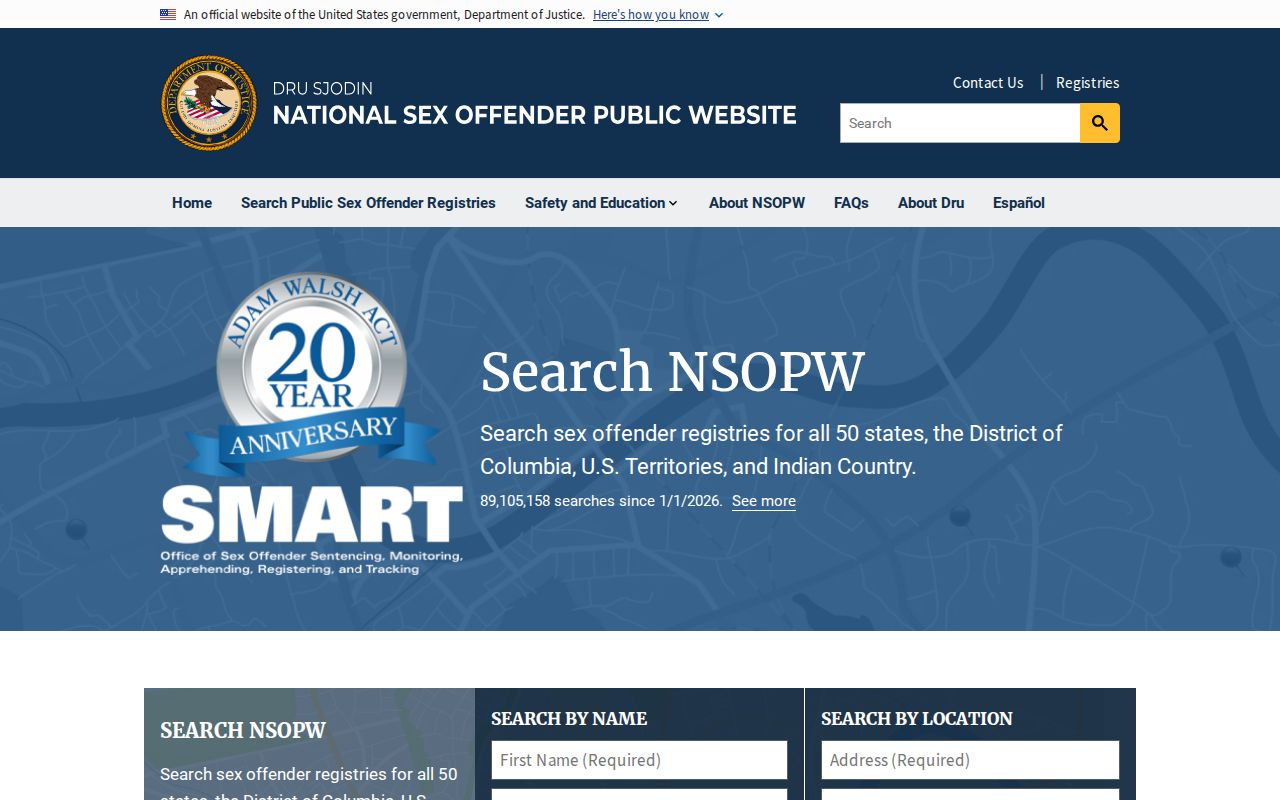
Compare a national match with the source-jurisdiction profile, since state publication rules and update timing can differ.
If two records appear similar, confirm aliases, offense jurisdiction, and profile status. Do not rely on the map pin alone. A dense group of pins can overlap, and an address may be shared with people who have no registration duty. The responsible sequence is official search, official profile, and an agency question when the facts do not line up.
Inside a Registry Profile
A publicly releasable profile can identify a registrant and describe the registration record. It is not a criminal case docket, a current risk score, or a complete list of everyone convicted of a sex offense. Each displayed field should be read in the context of the profile's status and update information.
| Name and aliases | Published identity names and aliases used to distinguish possible matches. |
|---|---|
| Photo and description | A photograph, physical description, and identifying scars, marks, or tattoos when legally publishable. |
| Registered address | Published residence or location information; mapping can be approximate and changes may still be processing. |
| Offense details | Offense description, statute, jurisdiction, and date shown by the official entry. |
| Registration category | The New Mexico operational classification and related verification schedule, not a federal risk tier. |
| Status information | Registration or compliance status and available verification or update details. |
| Other public fields | Vehicle, school, or work information may appear only when New Mexico law permits publication. |
Some fields are intentionally absent. New Mexico DPS cautions that not every person required to register is publicly publishable, and not every person with a sex-offense conviction has the same registration duty.
Hidden Doña Ana Registry Duties
“Non-releasable” is a legal publication status. It does not mean that the person has no duty to register with the Doña Ana County sheriff. Three of the five DPS operational categories expressly describe registrations without a public profile. That is why a missing person or address should not be turned into a claim that the registry is wrong or the area is free of all registration duties.
Duration also cannot be read from the category name alone. It depends on the qualifying offense and relevant conviction, release, incarceration, or supervision dates. DPS states that New Mexico SORNA applies to qualifying people convicted, incarcerated, or on probation or parole as of July 1, 1995. The current statute and DPS FAQ should control any individual duration question.
Note: Verification frequency describes how often a person reports; it is not a plain-language measure of dangerousness or future conduct.
New Mexico Registration Levels and Requirements
New Mexico publishes five DPS classifications rather than substituting federal Tier I, II, and III labels. The table preserves those exact operational categories. It does not invent a fixed term because duration is offense- and date-specific.
| DPS FAQ classification | Verification/publication meaning | Duration |
|---|---|---|
| 90 Day Re-Registrants | Report every 90 days; releasability is governed by law | Depends on qualifying offense and relevant dates |
| 90 Day Non-Releasable | 90-day duty but no public profile | Depends on qualifying offense and relevant dates |
| Annual Registrants | Annual registration; publishable when statute permits | Depends on qualifying offense and relevant dates |
| Annual Non-Releasable | Annual duty and no public profile | Depends on qualifying offense and relevant dates |
| Semi-Annual Non-Releasable | Twice-yearly duty and no public profile | Depends on qualifying offense and relevant dates |
People moving into New Mexico report to the county sheriff and should bring their judgment, sentence, and police report. DPS guidance also distinguishes visitors by relevant dates: older qualifying convictions can trigger duties after more than 14 days or more than 30 aggregate days in a calendar year, while certain post-July 1, 2013 convictions require registration within five days. Verify any personal deadline with DASO or DPS.
The New Mexico Legislature is an official source for current SORNA text and amendments.
Checking current law avoids turning a verification label into an unsupported duration or risk claim.
Doña Ana Registry Location Limits
New Mexico DPS states that there is no statewide residential-distance restriction for registered offenders. That means the state registry should not be read as a map of a universal school, park, or day-care buffer. A specific person may still have probation or parole conditions that restrict where that person may live. Those conditions come from supervision or court orders, not a statewide distance rule applied to every Doña Ana County registrant.
When a possible supervision violation is the issue, contact the appropriate NMCD probation and parole office rather than confronting anyone at an address. NMCD Region III serves Doña Ana County, including specialized sex-offender supervision. Court records can show the sentence ordered, while NMCD confirms present operational supervision. These sources complement the public registry but do not expand what the registry itself proves.
Doña Ana Registry Email Notices
The New Mexico registry allows users to enroll for neighborhood email notifications. An alert can support ongoing awareness when a published record changes or a releasable registrant is listed near an address. It should be treated as a prompt to open the current official profile, not as a substitute for reading the record. Address data can change, and shared properties can include people who have no link to the registration.
For suspected noncompliance, contact the Doña Ana County Sheriff's Office registration authority or NMDPS SOR at dps.sorna@dps.nm.gov or 505-476-2444. Confirm the DASO registry appointment, office hours, and exact counter before travel because no direct local unit phone or fee was verified in the official source set. Immediate danger belongs with 911.
Community Notification and Lawful Use
Registry information supports personal, family, and community awareness. It does not invite contact with a registrant or the occupants of a listed address. Before acting on a result, open the official profile, check its status and update details, and report suspected inaccuracies or noncompliance to DASO or DPS. The New Mexico Courts source explains the state's broader public-access system.
Public access does not remove the need for context, accuracy, and lawful conduct.
Use the registry lawfully: New Mexico SORNA governs publication, and IPRA access does not authorize misuse. Never harass, threaten, intimidate, confront, or use registry information to commit a crime against a registrant, household member, or occupant of an address.
A mistaken address, a move still being processed, or an approximate pin can harm uninvolved people when repeated without context. Search the official system, use notification signup when useful, and let the responsible agency investigate reported noncompliance. A request for an identifiable, existing DASO record can use the Doña Ana County IPRA channel, but IPRA does not replace registry reporting.